



















What does a climate tech design agency do differently?
A climate tech design agency has to make a hard technology look both investable and buyable, and those are two different jobs. Investors want the size of the problem, the cost curve and the team. Buyers, such as a utility, a project developer, an industrial plant or a corporate sustainability lead, want specifications, deployment evidence, integration details and someone accountable when it goes wrong.
Many climate sites are built only for the first audience. They're heavy on mission and light on what the product does, how much it costs to run and where it's already working. That reads well in a fundraise and stalls in procurement. We plan the site around the buyer's evaluation, then make sure the investor story is clear on top of it. Our guide to climate tech website design covers the full approach.
Why does climate branding all look the same?
Climate branding looks the same because most companies reach for the same signals of 'sustainable': green palettes, leaves, globes, wind turbines at sunset and soft gradients. Those signals tell a buyer you care about the planet, which every competitor also says, and they say nothing about whether your technology works.
A stronger climate brand is built from what's specific to you. A battery company might use the geometry of its cells and real installation photography. A grid software company might build its identity around load curves and maps. A carbon removal company might use its own measurement data as a visual system. The tone should be engineering-confident rather than hopeful. Our article on climate tech branding beyond green and leaves walks through more directions, and climate tech website examples that avoid greenwashing clichés shows live patterns worth studying.
How do you make environmental claims you can defend?
Make every environmental claim specific, qualified and sourced, and put the method one click away. In the US, the FTC's Green Guides (16 CFR Part 260) set out how the agency views environmental marketing claims. They warn against broad, unqualified claims such as 'eco-friendly' or 'green', and they expect carbon offset claims to be quantified with competent and reliable scientific and accounting methods.
- Say what, how much and compared to what: 'reduces process emissions compared with the system it replaces', with the basis stated, beats 'cleaner'.
- Separate measured from modeled: label projections and lifecycle estimates as estimates, and say who produced them.
- Publish the method: a methodology page with boundaries, assumptions and any third-party verification you actually hold.
- Date your numbers: state when each figure was measured and update the page when it changes.
If you sell to European consumers, the EU has also adopted rules restricting generic environmental claims, so check with counsel how they apply to your marketing. Our guide to greenwashing and your website covers claim patterns in detail.
What pages does a climate tech website need?
A climate tech website needs pages that let a buyer evaluate the technology and an investor understand the opportunity. We plan from the set below, then cut it to the six pages that matter most for your stage.
Page | Main reader | What it has to answer |
|---|---|---|
Home | Everyone | What the technology does, for whom, and the proof it works |
Technology | Engineers, technical buyers | How it works, specifications and integration requirements |
Solutions by customer | Utilities, developers, industrials | What each buyer gets, in their own terms |
Projects or deployments | Procurement, investors | Where it's running, at what scale, with dates |
Methodology | Sustainability leads, verifiers | How impact is measured, boundaries and assumptions |
Team | Investors, partners | Founders and engineers with relevant track record |
Careers | Engineers and scientists | Roles, mission and how the team works |
Contact or partner | Buyers, partners | Who to talk to for pilots, offtake or partnerships |
For energy and grid software specifically, our article on energy and utility software website design covers the pages utilities expect.
How do you show hardware and deployments on a climate site?
Show the real thing, in context, with specifics. Buyers of physical technology want to see the unit, the installation and the site, so real photography and short video of deployments do more than any render. When a deployment is too early to photograph, an accurate technical illustration labelled as such is better than a glossy concept image that looks like a finished product.
Deployment proof works best as structured content: a project page or card for each site with the location, the scale, the date and the partner, if the partner agrees to be named. We build these as CMS entries, so a new pilot is a new entry, and the home page, the map and the solutions pages pick it up automatically. For carbon accounting and ESG products, the proof is the dashboard itself, and our guide to carbon and ESG dashboard design covers how to show it.
Hypothetical example: turning a mission page into a buyer page
For example, suppose a heat-pump startup's home page leads with a line about decarbonizing buildings and a photo of a forest. A facilities buyer can't tell what size of building it suits or what installation involves.
The rewrite leads with the building types the product fits, a photo of an installed unit, and three facts the buyer needs: what it replaces, what installation involves and where to see one running. The mission moves to the about page. This is an illustration of the method, not a real company's site.
What work have we done that fits climate tech?
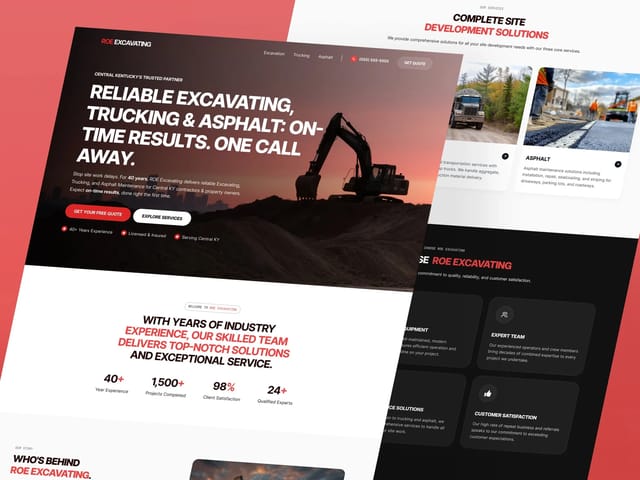
Our case studies don't include a climate company yet, so here is the work that maps onto the problem. We designed and built Update.ai's website, where the job was turning a complex product into a clear story. We designed and built the ROE Excavating site for a company selling excavating, trucking and asphalt work to contractors and property owners, which meant writing for practical buyers who want to know who shows up and what gets done. We designed and built LeanScale's conversion funnel for a B2B consulting offer, built around education and authority.
Those three problems, complex explanation, practical industrial buyers and education-led B2B selling, are most of what a climate tech site has to solve.
How does our process work for a climate startup?
Intro call
A free 30-minute call about your technology, buyers, stage and current site. We'll recommend a sprint, a site or both.
Buyer and claims review
We map who evaluates you, list every environmental claim on the current site and mark what needs a source, a qualifier or a rewrite.
Positioning and copy
We write the story for buyers and investors, with claims tied to the evidence and the method your team provides.
Brand
A refresh or new identity built from your technology, with photography direction and data visualization styles.
Design
Custom design in Figma for technology, solutions, deployments and methodology pages.
Build and launch
A Next.js build with a CMS for projects, news and roles, then launch checks, your counsel's review and a handover.
What does a climate tech website cost?
Our website package is $8,000, fixed, for up to six pages, then $500 per extra page. It covers copy, custom design, the Next.js build, a CMS and animation. The brand and design sprint is $3,000 and covers a brand refresh or redesign plus ten website or product explorations in Figma. Teams publishing new deployments, reports and grant announcements can move onto our $6,000 monthly retainer after launch.
- Website, up to 6 pages
- $8,000
- Brand and design sprint
- $3,000
- Ongoing design and development
- $6,000/mo
Timelines are scoped on the intro call. Our climate tech website cost and agency guide explains what drives the price and what to ask any agency before you hire.
The next step is a free 30-minute call. Bring your current site, your deck and a list of the claims you most want to make.